26 July 2026
Ocean fronts can divide fisheries as well as attract them
A global analysis shows that thermal fronts often separate fishing activity between warm and cold waters, an effect obscured when fronts are treated only as aggregation zones.
- Sector
- Environment
- Animal groups
- Fish
- Content type
- Scientific news
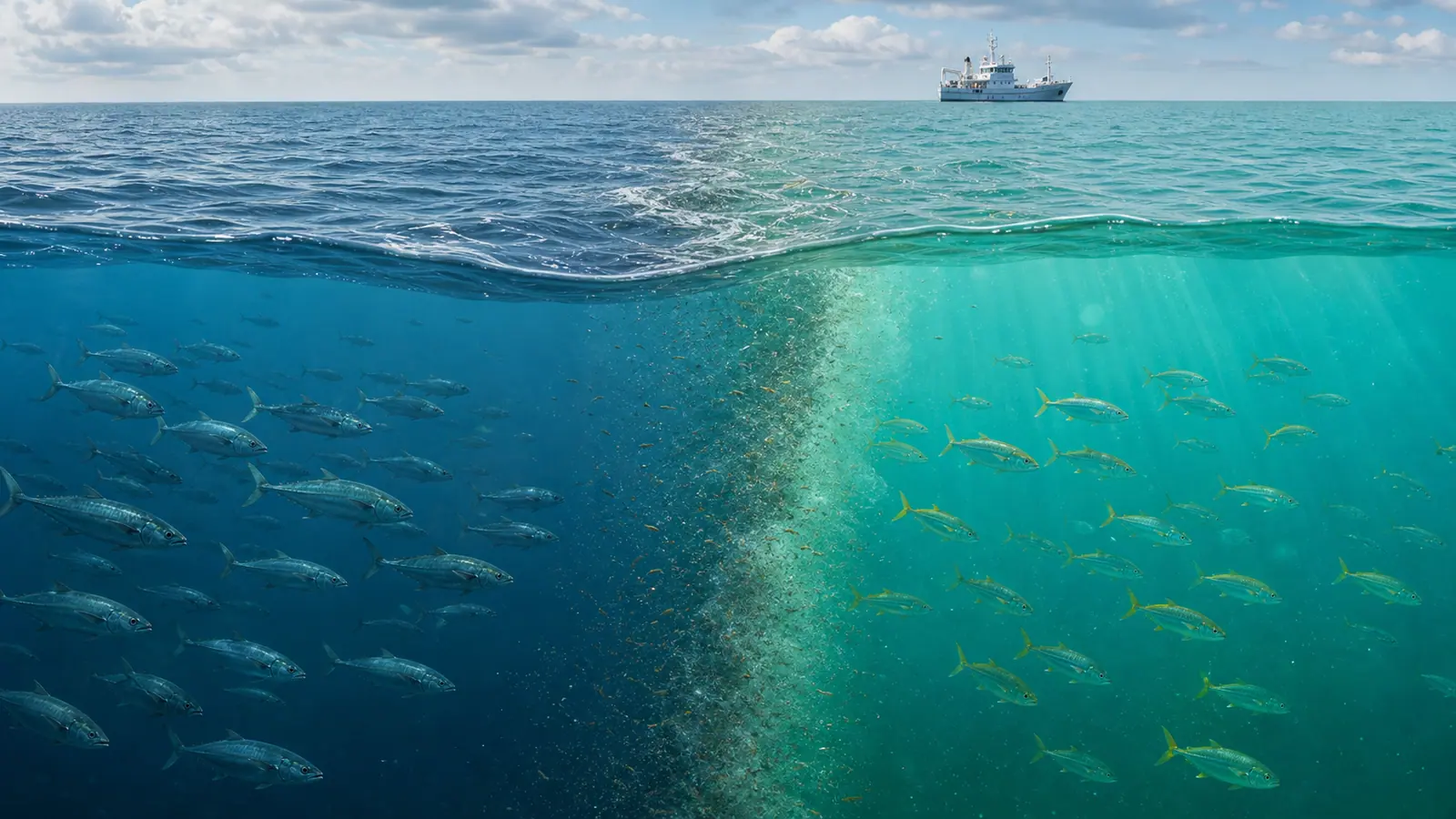
An ocean front is not merely a line where organisms and fishing vessels gather. A global study in Nature Communications shows that it can also separate two water masses used very differently by fish and fisheries. By distinguishing the warm side from the cold side, the researchers reveal a “barrier effect” associated with species-specific thermal preferences. This finer perspective may improve habitat models and prevent a lack of apparent aggregation from being mistaken for a lack of ecological influence.
Hotspots and barriers are different questions
Ocean fronts are narrow zones where water masses with contrasting temperature, salinity or other properties meet. Their convergence and mixing can bring nutrients into surface waters, support phytoplankton and concentrate drifting plankton. They have therefore become widely recognised as biological hotspots that attract fish, predators and fishing activity.
That familiar description often combines observations from both sides of the front. Yet an ectothermic fish does not experience the same conditions in the warmer and colder water masses. A species may be common on one side and scarce on the other without producing a strong average concentration around the frontal line. In that case, the front behaves as a thermal boundary rather than simply as a meeting point.
Qinwang Xing and colleagues used a satellite detection method that delineates those two sides. They combined the resulting maps with commercial catch records, fishery-independent surveys and a global vessel-derived fishing activity dataset. The broader analysis included 11 regions influenced by major boundary currents or upwelling systems, six gear types and 25 individual fishery stocks.
Species, seasons and gears do not respond alike
Observed distributions differed by 15–70% between the warm and cold sides of fronts. The authors linked these contrasts to local thermal habitat suitability. Squid and Pacific saury favoured different sides, while mackerel and sardine shifted their apparent preference seasonally. There is therefore no universally productive side of an ocean front.
Across 1,000 random simulations, 53 of 57 regional fishery combinations showed a statistically significant barrier effect. Pole-and-line fisheries, some purse seines and trawlers displayed the strongest contrasts, with mean activity differences of 40–70% between warm and cold zones. Drifting longlines had a weaker response of about 15%. Their operations can extend over tens of kilometres, the authors note, so recorded vessel locations may be separated from the actual capture point and blur a fine-scale frontal signal.
The conventional hotspot effect—comparing frontal with non-frontal waters—was more sporadic and usually smaller, often in the 5–20% range. That does not mean that fronts have ceased to be productive. High use of the favourable side can be offset in an average by avoidance of the unfavourable side. When the contrast is ignored, the study estimates that the overall influence of fronts on fishery distribution is underestimated by 55–75%, depending on the metric.
These percentages are relative differences within the datasets analysed. They are not equivalent changes in true fish abundance, nor guaranteed gains in catch. Vessel behaviour also reflects prices, quotas, weather, port access, skipper knowledge and regulation.
Implications for marine monitoring
Maps of frontal frequency already support habitat studies, survey planning and interpretation of tracked-animal movements. The new analysis argues for moving beyond distance to the frontal line alone. Where data allow, models should represent the warm water mass, the cold water mass, season and the thermal preference of the target taxon.
That distinction becomes particularly useful in a warming ocean. A moving front or changing thermal contrast may rapidly alter a stock’s local availability without necessarily indicating an equal change in its total abundance. Managers therefore need to combine satellite products with fishery-independent surveys, catch-per-unit-effort data and species-specific biology.
The study has important limitations. Global activity data can misclassify fishing gear or estimate fishing hours imperfectly. Remote-sensing algorithms do not identify every front, especially when cloud limits sea-surface temperature observations. Seasonal reversals can be dampened when information is aggregated, and well-documented fisheries may not represent complex coastal systems or poorly monitored species.
The statistical tests also identify association, not a single causal pathway. Temperature is a plausible organising mechanism and habitat-suitability analyses support it, but prey fields, currents, oxygen, reproductive movements and fleet decisions can contribute to the patterns. Local validation remains essential before a frontal product is used operationally.
Better interpretation, not a universal fishing rule
For practitioners, these findings are not a recommendation to target one side of every front. They are a reminder to interpret apparent shifts alongside temperature, season, species and gear. A cluster of vessels does not prove a proportional concentration of fish, while a weak average around a front may hide two strong but opposing responses.
Vetofish can help organisations connect environmental data, field observations and biological indicators when designing monitoring protocols, investigating spatial anomalies or communicating climate-related findings. The practical starting point is to define the process under study: a productivity hotspot, a habitat boundary or a shift in availability require different evidence and different management responses.
Reference
- Xing, Q., Gao, Z., Ito, S.-i. et al. (2026). “Underestimated barrier effects of ocean fronts shape global fishery distribution.” Nature Communications, 17, 4545. 10.1038/s41467-026-71250-0